Entrepreneurship Isn't Just Building a Business. It's Building Something That Lasts.
A founder's 10 principles for building a sustainable business, from vision and cash flow to team, customer trust, systems, and long-term thinking in the age of AI.
By Sudhir Gorade · Founder
- Entrepreneurship
- Leadership
- Business Growth
- Startups
- Artificial Intelligence
- Building
- IT Industry
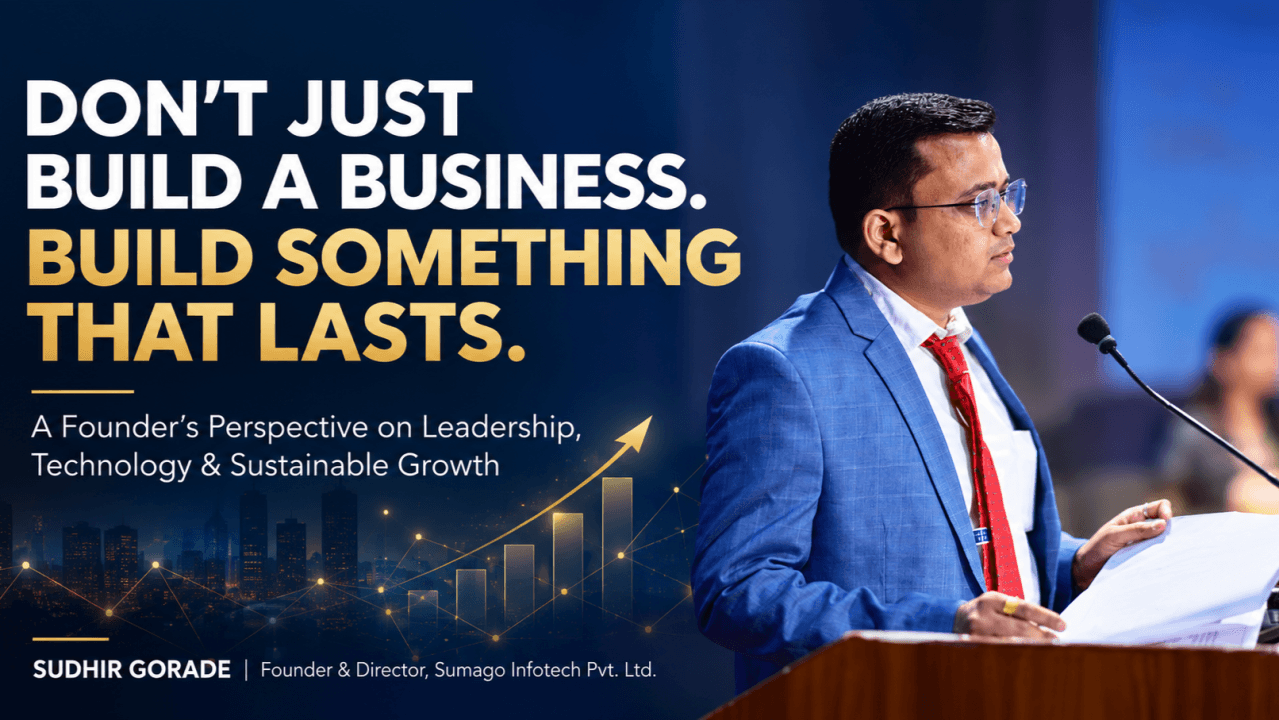
Reflections on business growth, leadership, technology, and the entrepreneurial journey.
As a founder, one of the most important lessons I have learned is that starting a business requires courage, but building a sustainable business requires a completely different level of thinking.
The early days of entrepreneurship are often driven by passion, ambition, and the desire to create something meaningful. As the business grows, however, the challenges evolve. You move from finding your first customer to retaining hundreds of customers, from managing a small team to building leaders, and from executing projects yourself to creating systems that can operate and grow beyond your individual efforts.
Entrepreneurship is not a straight road towards success. It is a continuous process of learning, adapting, making difficult decisions, and moving forward even when the outcome is uncertain.
Having worked in the IT and technology ecosystem, I believe there are several important principles every entrepreneur should reflect upon.
1. Don't Just Build a Business. Build a Vision.
A business without a clear vision can remain busy without making meaningful progress.
Entrepreneurs must ask themselves: What problem are we solving? Who benefits from our work? What difference will our business make five or ten years from now?
In the technology sector, opportunities are everywhere. Artificial Intelligence, automation, cloud computing, cybersecurity, digital transformation, and emerging technologies are opening new doors every day.
But chasing every opportunity is not the same as building a successful company.
The real skill lies in identifying the right opportunities and developing the capability to execute them exceptionally well.
A clear vision helps an entrepreneur decide not only what to pursue, but also what to decline.
2. In the Age of AI, Continuous Learning Is a Business Strategy
Technology is changing faster than traditional business practices can keep up with.
Artificial Intelligence is transforming how companies develop software, serve customers, analyse information, train employees, and make decisions. What once required an entire team may now be accomplished more efficiently with the right tools and workflows.
For an IT entrepreneur, staying updated with technology is no longer optional. It is a responsibility.
However, adopting technology simply because it is trending is not enough. The objective should be to use it to solve real problems, improve productivity, reduce unnecessary costs, and create measurable value for customers.
I believe the next generation of successful companies will not necessarily be those with the largest teams, but those that combine talented people, intelligent systems, and a culture of continuous experimentation.
The question every founder should ask is: Are we becoming more capable every year, or are we simply becoming bigger?
3. Revenue Creates Possibilities. Cash Flow Creates Stability.
One of the realities of entrepreneurship is that a company can have a strong order book, impressive revenue figures, and a growing customer base while still experiencing financial pressure.
Business growth and financial health are not always the same thing.
Founders must understand the difference between revenue, profitability, and cash flow. Delayed payments, uncontrolled expenses, underpriced projects, and poor financial planning can put pressure on even a promising business.
Every entrepreneur should regularly review:
- Revenue and actual profitability.
- Operating expenses and financial commitments.
- Customer payment cycles and outstanding receivables.
- Project-wise costs, margins, and resource utilisation.
- Available cash and upcoming financial obligations.
Growth should be ambitious, but financial decisions must remain disciplined.
A healthy business is not measured only by how much work it wins, but also by how effectively it converts that work into sustainable value.
4. Your Team Is Not Just Your Workforce. It Is Your Growth Engine.
In the early stages, founders often become involved in almost every decision. This may help establish the business, but it can eventually become a barrier to growth.
If every decision depends on the founder, the organisation's growth remains limited by one person's time and capacity.
The real transition in leadership happens when a founder begins building people who can think independently, take ownership, solve problems, and lead others.
This requires investing in training, communicating expectations clearly, delegating responsibility, and creating an environment where people are encouraged to contribute ideas.
In an IT company, where skills and technologies evolve rapidly, the ability of a team to learn and adapt can become a significant competitive advantage.
Your organisation becomes stronger when your people can make good decisions even when you are not in the room.
5. Customer Trust Is More Valuable Than a Single Project.
Winning a project is an achievement. Earning a customer's long-term trust is a much greater one.
In the IT services industry, customers are not simply buying software, manpower, or technical expertise. They are trusting a company with their business challenges, timelines, resources, and expectations.
That trust is built through transparent communication, realistic commitments, consistent quality, and accountability when things do not go according to plan.
Not every project will be easy, and not every expectation will be achievable. But honest communication and a genuine commitment to finding solutions can strengthen professional relationships.
Long-term business growth often comes from repeat customers, referrals, partnerships, and a reputation built over years of consistent delivery.
Never underestimate the value of doing what you promised, when you promised it.
6. Stop Making the Founder the Solution to Every Problem.
As entrepreneurs, we often take pride in our ability to solve difficult problems. But there is a stage in business when constantly solving problems ourselves stops being a strength and starts becoming a limitation.
Instead of repeatedly addressing the same operational issues, we must ask:
- Why does this problem keep occurring?
- Is there a missing process or unclear responsibility?
- Can technology automate this activity?
- Does the team need better training or decision-making authority?
- How can we prevent the problem rather than solve it repeatedly?
This is where systems, standard operating procedures, performance metrics, and automation become essential.
A founder's role gradually shifts from managing individual tasks to designing an organisation that consistently delivers results.
Don't just solve problems. Build systems that make those problems less likely to return.
7. Networking Is Important, but Collaboration Creates Real Value.
Entrepreneurship can sometimes feel like a lonely journey. Many challenges are difficult to explain to people who have never carried the responsibility of running a business.
Connecting with fellow entrepreneurs, industry leaders, mentors, investors, institutions, and technology communities can provide new perspectives and opportunities.
But effective networking is not about collecting contacts or exchanging business cards.
It is about creating meaningful relationships, sharing knowledge, understanding each other's strengths, and identifying opportunities to collaborate.
Especially in the IT industry, where solutions often require multiple capabilities, partnerships can create value that no single organisation could deliver as effectively on its own.
The best professional relationships are built on mutual respect and long-term value, not just immediate business gains.
8. Scale Your Impact, Not Just Your Turnover.
As entrepreneurs, we naturally focus on revenue, customers, projects, and expansion. These are important measures of business performance, but they do not tell the complete story.
We should also ask ourselves:
- How many people have we helped grow professionally?
- How many meaningful employment opportunities have we created?
- Are we helping students and professionals become future-ready?
- Are our solutions addressing genuine industry or societal challenges?
- Is our organisation becoming more responsible as it becomes larger?
For a technology company, creating value can extend far beyond delivering IT solutions. It can include developing talent, improving access to digital skills, enabling businesses to adopt technology, and contributing to innovation.
A business becomes more meaningful when its growth creates opportunities for others.
9. Resilience Is Not About Never Failing. It Is About Learning Faster.
Every entrepreneurial journey includes moments when plans do not work, customers change direction, projects get delayed, markets shift, or decisions produce unexpected outcomes.
Resilience does not mean pretending that every challenge is an opportunity or ignoring the seriousness of difficult situations.
It means confronting reality, learning from mistakes, seeking advice when necessary, adjusting the strategy, and taking the next responsible step.
Sometimes, progress means moving faster. At other times, it means pausing, reassessing priorities, reducing unnecessary risks, and strengthening the fundamentals.
The ability to distinguish between persistence and stubbornness is an important part of mature leadership.
You do not have to get every decision right. But you must be willing to learn from every important decision.
10. Protect Your Long-Term Thinking in a World Obsessed With Quick Results.
Building a sustainable company takes time.
There will be periods of rapid growth and periods when progress feels slower than expected. There will be achievements that receive recognition and difficult decisions that nobody else sees.
Not every investment will produce immediate returns. Not every initiative will succeed. Not every milestone will happen according to plan.
The challenge is to remain ambitious without becoming impatient, flexible without losing direction, and optimistic without ignoring reality.
Short-term performance matters, but it should not come at the cost of long-term credibility, employee well-being, customer trust, or financial stability.
The objective is not merely to build a company that grows quickly. It is to build one that can adapt, remain relevant, and create value over time.
A Few Questions Every Founder Should Ask Themselves
At the end of every month, take some time away from daily operations and reflect on these questions:
- 1.Are we working on the right priorities, or are we simply staying busy?
- 2.Is our business financially healthy, beyond the revenue numbers?
- 3.Are we using technology and AI to improve how we operate?
- 4.Is our team becoming more independent and capable?
- 5.Are our customers receiving the value we promised?
- 6.What recurring problem should we eliminate through a better system?
- 7.What should we stop doing to make room for more meaningful growth?
- 8.Are we building something that can succeed beyond our personal involvement?
Honest answers to these questions can be more valuable than another month of activity without reflection.
Final Takeaways for Aspiring Entrepreneurs
Entrepreneurship is a continuous journey of balancing ambition with discipline, innovation with execution, growth with financial responsibility, and individual leadership with collective capability.
As founders, we cannot control every market condition, customer decision, or external challenge. But we can control how well we prepare, how thoughtfully we make decisions, how responsibly we manage resources, and how consistently we learn.
I believe the future belongs to entrepreneurs who combine vision with execution, technology with human intelligence, ambition with financial discipline, and growth with purpose.
Because ultimately, success is not just about how far we take our business.
It is also about how many people grow with us, how much value we create, and what remains stronger because we chose to build something meaningful.
Keep learning. Keep building. Keep adapting. And never stop creating value.
— Sudhir Gorade, Founder & Director | Sumago Infotech Pvt. Ltd.